
Sears, Roebuck & Co.

On the likely eve of its demise as a major retailer, it seems appropriate to recognize the role played by Sear, Roebuck & Co. in transforming the landscape of small-town America in the early 20th century.
In addition to washtubs and lingerie, Sears also marketed single-family homes through catalogue sales. Though Sears may be in its final days as a collection of real stores, lets hope its corporate archives don’t disappear, for there you will find a comprehensive record of its residential product offerings.

I happened to find a postcard image in my collection of what I am convinced was a Sears home (though on-line sources don’t conveniently confirm this) and include it here to represent the sort of working- and middle-class homes the company sold in kit form. Yes, you would literally receive the entire house—minus bricks, concrete blocks and mortar—on a flatbed rail car at the siding nearest your construction site. Everything else was included: studs, beams, rafters, windows and doors, lath and plaster, trim and cabinets, shingles, etc. From the aughts to the 30s, hundreds of this homes were built across American, delivered from two primary fabricating plants.
Once you’ve seen the catalogue, you’ll be hard-pressed to drive down any street without finding at least one. For me the question becomes “How soon were they present in Agincourt?” and “How many might legitimately be woven into the residential neighborhoods?”
Gulley Jimson [1918-1982]
[From the catalogue-in-progress for “Landscapes & Livestock”, a loan exhibition for Agincourt Homecoming in the Fall of 2015]
JIMSON, Gulliver / Gulley [1918–1982]
Study for “The Raising of Lazarus”
1958
oil on wood panel / 9 inches by 12 inches
Eccentric British artist, Gulley Jimson—immortalized in Joyce Cary’s novel The Horse’s Mouth—would not have wanted to be a member of a club that would have him. A “man of the people” who offended potential patrons with visceral subjects rudely presented, yet collectors competed to own his “kitchen sink realism”.
Jimson found his models in, of, and on the streets of London. Such was probably the case for his monumental “Raising of Lazarus” painted in 1959: a collection of calloused, bunioned, rheumatoid, and arthritic feet abused by Britain’s docks and mills and farm fields and war. Such feet today are the more likely consequence of fashion. This small study was one of several he created for each new work.
During a history class field trip to London in the summer of 1987, NINC senior Emma Spofford found this painting in the famous Portobello Road Flea Market. After authenticating it as a genuine Jimson, she gave it to the Community Collection for a charity auction. The work was never offered for sale.
The lack of an illustration is easily explained: I haven’t painted it yet. But with advice like this from my artist-advisor Jonathan Rutter, how can the mark elude me:
Don’t romanticize the feet. Paint directly and heavily. Enjoy the sinews, the veins, the discolorations, the calloused knobs, the not-quite-right-ness of every toe. And take some license with your palette.
Introspection
“I’m not the person I once was. Indeed, I may never have been.” — R.H.L.M. Ramsay
I attended a presentation recently that should, on its surface, have harmonized with Agincourt. On deeper consideration—as I listened with anticipation to its author, hoping to find a kindred spirit, but began to see its design through words other than those I’d supplied as a first-time casual observer of beautiful drawings hanging on a wall—it came to be something else; something quite different. What you see is not always what you get. At the end of an hour, I was left with so little frame of personal reference as to be speechless. Imagine that. Nothing to say. And today, almost as little to write.

It was a curious experience, coming to this gradual realization that what had initially intrigued me may well be the Anti-Agincourt. That two notions of playing in the sandbox of history could be simultaneously both apposite and opposite was a surprise. If I am shaken in some way, disconcerted, it is largely due to my own misperception; my misreading of what had hung so objectively before me.
Go figure. I’m trying to.
Geology (I always found the word “schist” titillating)

As a student of the earth sciences, I am newborn. Could rock formations such as these underlie portions of Fennimore county? Your guess may be better than mine. In that likelihood, I welcome a conversation about the potential geological underpinnings of Agincourt with anyone inclined.
This image, by the way, was taken near Mason City in the north central part of the state. Anson Tennant’s maternal grandfather lives near Mason City, incidentally, so he might have encountered the Prairie School works of Wright, Walter Burley Griffin, William Drummond and a few lesser lights there.
Lustron!
Without question the most plentiful building type in Agincourt and its satellite communities is housing, the vast majority of it single-family. And among those hundreds of houses will be an amazing array of historical styles. One that I especially hope for is the Lustron.
The Lustron home was on my radar at about the age of six or seven, certainly by eight or ten. Jerry Rasmussen, on of my grade school classmates, lived in one. His dad was president of the local bank, and the Rasmussens lived in the newer post-WWII side of Bedford Park, a Chicago suburban where I was born. While I may not have played there very much, the hard enamel and exposed concrete slab seemed unusual—especially given the very orthodox wood-framed 1920s house I lived in with my parents and grandparents. Some of you not acquainted with the Lustron phenomenon may enjoy this mini history lesson, though I’m writing this from an increasingly faulty memory.
After WWII, an airplane assembly line in Ohio—necessary for the war effort but now out of commission—was available for purchase. Someone with the prematurely bright idea that the American building industry might profit from an assembly-line process acquired the plant with the idea of mass-marketing single-family homes. Major urban areas might have a Lustron franchises, a showroom to display the product and a skilled crew ready to assemble one on your lot. Shipped from the factory on a flatbed truck, all the components of a complete two- or three-bedroom home arrived ready for assembly on your concrete slab.


Fargo-Moorhead have a half dozen in varying states of intact-ness; several others are scattered about the region. I’ve seen them in Wadena, MN, Devlis Lake, ND and even Murdo, South Dakota, whose only (other) claim to fame is changing your watch while crossing into another time zone. Wondering if there were many Lustrons in Iowa, the internet has generously provided a list of well over a hundred. So the addition of one in Agincourt is not only logical, it’s a sure thing.

This image if a Lustron located in Cedar Rapids, but there is one much closer to Agincourt at the northwest corner of Cayuga and Maple Streets in Pomeroy, IA.
Grou (again)
Circular configurations occur more often in the natural world than do the rectangular impositions of human kind. To be “right with the world”; for a straight line to be “normal” to a flat surface; to have been our distant relative homo erectus is to be shaped by the ninety-degree angle. Indeed, though we have become sapient, we are no less erect.
The Old, New, newer and newest testaments—those of Judaism, Christianity, Islam and even the LDS—speak of a world bisected axially (usually by rivers) and of the four resulting quadrants and the corners of the Earth. As someone educated in architecture I’ve likewise been indoctrinated with the logic, the inevitability of ninety degrees. Which make circles all the more remarkable. Consider the Abbasid capital of the Islamic world, Baghdad.

From its founding in A.H. 150 by the caliph al-Mansur until about the Islamic year 300 (912 C.E., for the calendrically challenged) Baghdad was the center of science and learning and may have been the largest city in the world, achieving a population of at least a million. The caliph had envisioned his city as an ideal, a center for learning, a hub for commerce—the real and metaphorical center of the Islamic world. Shortly before his death in 1959, Frank Lloyd Wright was one of several Western architects commissioned to bring the city to “world class” status. Wright did his homework, planning an opera house, museums and a university in harmony with al-Mansur’s original vision.

Wright had discovered his compass late in life but made good use of it for several circular, radial and/or spiral designs: the Sugar Loaf observatory, a home for his son David in Scottsdale, the Guggenheim, among others. As I was nurtured on the earliest Prairie School work in greater Chicagoland, these point-generated buildings weren’t easy to accept. Age has given me perspective, if nothing else, and they seem to me now the product of just the most recent of Wright’s nine lives.
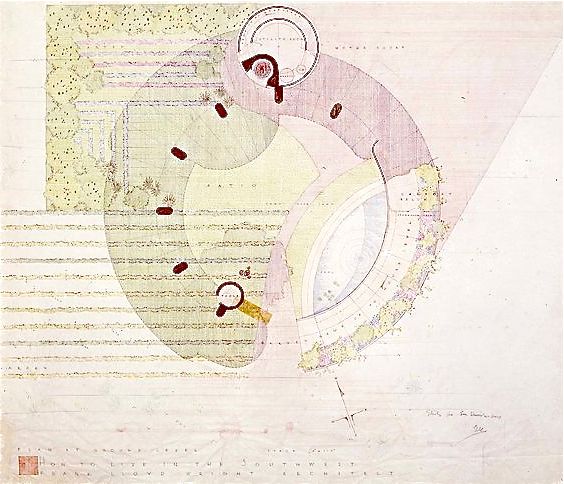
In a very different context, I became interested in American urban planning of the 19th century, remnants of the Enlightenment that spread westward with Manifest Destiny and left a legacy of circular town plans at such odds with the ubiquitous Jeffersonian grid that few of them have survived. Circleville, Ohio is a remarkable case in point: its circular plan has gradually disappeared after its founding in 1810.

The existential layering of X-Y axes and both circular and radial streets on a cartesian grid establish such a powerful sense of place that I was immediately drawn to its possibility when thinking of a smaller satellite community for Fennimore county. Grou would be its name, a nostalgic homeward glance by the Dutch (Frisian) settlers who came about 1890 to establish an agricultural community. Was theirs simply an idea brought with the rest of their cultural baggage? Or could it have been a literal plan in sepia ink on a sheet of durable laid paper? How would its subliminally communitarian form—obviously created in metric—have translated to the avoirdupois rectilinearity of Mr Jefferson? A little more time will tell.
Religion in Agincourt

In the spirit of truth in advertising, it may be time to write a bit about religion in the town of Agincourt and its hinterlands. Yeah, there is some, probably quite a bit.
In fact I know there is, because I’ve designed four of the city’s churches (Baptist, Methodist, Episcopal and Christian Science) and lent a hand with two others (Roman Catholic and Lutheran). But, like any good architect—remembering I’m not one—I can sublimate my own personal scale of values to aid in addressing the needs of others, without trying to impose those values on them. It was important a few weeks ago while visiting Notre Dame du Haute at Ronchamp, France to recall that LeCorbusier was an atheist. And that Louis Kahn, the less-than-Orthdox Jew, designed a magnificent mosque at Dakka in Bangladesh. Both of these guys were tapping into that which unites, rather than divides us, and the results are noteworthy in an age characterized by divisiveness and a tendency toward exclusivity.
On any given Sunday or Saturday or Friday—take your pick—is there religious activity in Agincourt? Are folks putting on their finer duds and traipsing across town or across the street to encounter the ineffable? Absolutely! If I found myself in town on one of those days, would I attend a service? Very likely. Especially in the company of my curious friend Howard Tabor.
I have, in fact, added several clerics to the story line already: Candace Varenhorst, for example, the Rev at Asbury United Methodist delivered a mighty fine sermon a few Sundays ago on the merit of letter-writing, given how many of them were written to the Philippians, the Corinthians, the Ephesians, and the Galoshes and now form several installments of the Newer Testament. Pastor Varenhorst performed the first same-gender marriage in Agincourt.
Saint-Joseph-the-Carpenter, Agincourt’s Episcopal church, has been shepherded by some quintessentially colorful characters, including the reverends Benjamin Franklin Cooley, Stephen Grimaldi, and Chilton Fanning Dowd (one a real person, two of my invention). Finally, there is the redoubtable Father Francis Manning, pastor for fifty years of Saint Ahab’s parish of Roman Catholics. Father Manning was, in fact, a 19th century woman who had felt “the calling” and sublimated her own gender for a ministry to others. But why stop at creating priests? I also invented Ahab.
Many aspects of a probable religious presence in Agincourt are, frankly, beyond my means. The Baptists, for example, are ABC (northern) rather than SBC (southern) Baptists. But why create characters intent on condemning me to their Hell? Christian Scientists base their belief on the writings of Mary Baker Eddy, whose vision told her that we have the power to heal ourselves through prayer or what I would prefer to characterize as meditation. As someone who has made himself sick through rumination, I can certainly support the contrary notion that I can make myself well, though Divine Scripture would have little to do with it. Christian Science is an aging denomination with a low birth rate, however, whose numbers unofficially are in significant decline. So, much as I might support Ms Eddy’s concept, I would attend one of her services only to appreciate the clarity of their architecture. And what of the Church of Jesus Christ of Latter-Day Saints? Their history is fascinating; their theology colorfully curious; their family values admirable. But here, too, I am not welcome as I am and will continue to be.
Toward the other more Fundamentalist end of the spectrum, there are choices in the Baskin-Robbins thirty-one-flavor lineup of Christianity that are simply not to my taste. Seek me not at the Antideluvian Pentecostal Holiness church requesting my snake. Not my thing, but go ahead if you want to. I am also less than likely to attend services that espouse the control of women’s reproductive rights (though I myself am Pro Life) or the corralling of homosexuals for shipment to barb-wired compounds in Wyoming (as has been promoted by James Dobson of Focus on the Family). These folks certainly have a right guaranteed by the Constitution to such views, but I also have a right to resist tax exemption for the places where they promote this crap.
Approaching the metaphorical sunset of my life—it’s already well past noon—I think now and again on death. Several feeds on FaceBook bring the discussion of both atheism and agnosticism to my doorstep, and I welcome the dialogue. I support the Theory of Evolution because it is scientifically demonstrable and will likely remain my preferred explanation for the Origin of Life until something equally testable comes along. I do not know that there is an intelligence beyond our own that may have been responsible for the creation of the cosmos. But, if there is, I suspect it is so far beyond human comprehension as to be unrecognizable. It is, in my opinion, not the Sky Guy father figure onto whom we have projected all the fears and foibles of human kind. Like the reprehensible Christopher Hitchens, the atheist we love to hate, I understand that “Religious faith is…ineradicable. It will never die out, or at least not until we get over our fear of death, and of the dark, and of the unknown, and of each other.” And to the extent that those fears exist in Agincourt, as elsewhere, yes, religion will be around for a long time.
In the meantime, I do not fear death. It is dying that gives me the beegeebees.
Antonio Maria Aspettati [1880-1949]

[From the catalogue-in-progress for “Landscapes & Livestock”, a loan exhibition for Agincourt Homecoming in the Fall of 2015]
ASPETTATI, Antonio Maria (1880–1949)
Woman in a Park at Evening / Donna in un parco di sera
circa 1905–1910
oil on wood panel / 7 inches by 10 inches
Information on Aspettati (in English) is scarce,¹ but a handful of auction records include nothing quite like this small Impressionist, borderline Symbolist work in a palate of melancholic secondary colors against a manic blue sky. A lone woman muses in a scruffy park. Two stone pines—also known as umbrella or parasol pines, a tree characteristic of the Mediterranean—divide the composition into what is nearly a Golden Section proportion. All is ennui.
Karl Wasserman received this work in trade—source unknown—for one of his own paintings.² “Woman in a Park” was bequeathed to the Community Collection on Wasserman’s death in 1972.
¹ “Nato a Firenze il 25 marzo 1880. Ha frequentato l’Accademia fiorentina. Cominciò ad esporre a 18 anni e da allora in poi ha partecipato a varie mostre locali e di fuori. Fu premiato alla “Mostra del Soldato” a Firenze e venne invitato alla VII Quadriennale di Roma. Si è specializzato in interni di chiese, di palazzi e musei, ove rende una esatta prospettiva con geniali effetti di luce. Alla Fiorentina Primaverile del 1922 espose l'”Interno della chiesa di Santa Trinità”. Altri suoi lavori sono: “Carnevale”; “Paese a Diaceto”; “La villa Forasassi”; “Il coro di Santo Spirito Quercie a Quintole”. E Socio onorario dell’Accademia di Belle Arti di Firenze.” — A. M. Comanducci, 1962
² It seems unlikely that Wasserman and Aspettati were acquainted.