
Home » 2013 (Page 10)
Yearly Archives: 2013
An unsolicited testimonial
Howard’s last column brought several unsolicited testimonials to his in-box, including this from one of Dr Cuijpers’ earliest cancer patients.

“A few figs from thistles…”
by Howard A. Tabor
Unsolicited Testimonial
There are times when writing this column is akin to pulling teeth: awkward and painful. [Perhaps reading it evokes a similar response.] Then there those occasions, on the another hand (and not often enough) when it writes itself. Such is the case this week when, on Wednesday, I received this letter from a reader in another part of the state. Though the writer didn’t ask for anonymity, I’ve extended her a courtesy by altering her name. Here is what she wrote:
“A friend in Agincourt sent me a copy of your recent column on Dr Cuijpers, who I recall as our family physician when I was a young girl. Though I was only twelve or thirteen at the time, and some of my memories so long ago are fading, it seems proper to share a story with you and your readers. Feel free to publish it.
“I had been playing volley ball during recess and fallen, with uncharacteristic weakness and pain in my left leg. They notified my mother and we went immediately to the doctor. X-rays were both cumbersome and dangerous then, and my parents were cautious about exposing me to high levels of radiation. Doctor Cuijpers took only one or two, as I recall, but based on those pictures of my thigh bone he took my parents aside and had a quiet conversation out of earshot that caused me to think the worst. Then he arranged for us to return later that afternoon, just when the office hours would be over.
“So at five o-clock we returned. Only Doctor Hank and his nurse (whose name I cannot now recall) were there. Mother and I went into the examining room where I put on a hospital gown and laid down on a low table. Through another door, Doctor returned with what I guessed to be his dog. Her name (he introduced me to her) was Poppy, and he explained that Poppy would like to get acquainted with me; that she would enjoy being my friend and that I shouldn’t be wary of her wet nose.
“Poppy spent some time beside me and in my lap while Mother chatted with Doctor. Her tail wagged and she licked my face. Then she became quite serious about my left hip, which struck me as very odd. Doctor placed some colored salve on her nose, which left marks on my skin wherever she took a special interest. Soon there was a concentration of wet dots from her curiosity and Doctor took pictures of those marks. I had little appreciation for what was going on but Mother explained long after my operation that it was Poppy’s keen sense of smell that had found the tumor pressing on my nerves, pressure that had caused the pain and weakness.
“I saw Dr Cuijpers and Poppy a few more times, but she took no interest whatsoever (as I remember it now) in my leg. Mother explained that the smell of the tumor had helped Doctor locate and remove it so thoroughly that I’d been cured. We moved to Dubuque a year or so later and I never had a recurrence of the problem. I also never saw Poppy again but wondered if she had helped others with her special talent. So thank you for the article about her grave at ‘The Shades’ and the story I had almost forgotten.”
There isn’t much more that needs to be said.

Youth and the other thing
Freshly returned from the Montana AIA Fall Conference (and trapped each way for four hours in cans of diseased air that we call “flying”), I’ve had plenty of time to reflect on the experience and conclude that growing old is inherently no bad thing. If Oscar Wilde is right—that youth is wasted on the young—though, I wonder which quality of life might be wasted at the other end of the aging spectrum—the place where I find myself. Happily the good ship HMS Youthful Naïveté has sailed on, abandoning me here to await the rescue ship captained by Charon and his crew.
Beach-bound and binocular-ed, I find myself scanning the horizon, whence cometh help.

And, so, this fragment of a poem by Philip Larkin came to mind:
And so it stays just on the edge of vision, / A small unfocused blur, a standing chill / That slows each impulse down to indecision. / Most things may never happen: this one will, / And realization of it rages out / In furnace fear when we are caught without / People or drink. Courage is no good: / It means not scaring others. Being brave / Lets no one off the grave. / Death is no different whined at than withstood.
[ From “Not to be here; not to be anywhere”, written in 1977]
Good will (hunting)

It is utterly astounding what can be accomplished with a little good will and google.translate.
From the relative comfort of an aeron chair…
From the relative comfort of an aeron© chair in the womb-like safety of an NDSU computer lab, it never ceases to amaze how much field work can be accomplished. This past week has been reassuring on that score.

The question of Gabriel Spat’s identity—to the world and to himself as well—continues to engage me. Aside from some required but depressing readings on the Chișinău pogroms of 1903 and 1905, there are only a few outstanding questions as I prepare to sit down and outline an article about Spat, who was not nearly as elusive as his on-line presence might suggest. I’m relatively confident that Spat and Numa Patlagean were, in fact, brothers two years apart in age. Internet sources on Patlagean offer tidbits of background from the Moldovan years, prior to his emigration to Paris. [Here, by the way, the pogroms of 1903 and 1905 would appear to almost literally be “the smoking gun” that drove him and Gabriel from their homeland.] Numa’s (or Naum or Nahum, take your pick) family are rumored to have owned a cement factory in Moldova’s capital city, which at that time supported about 125,000 residents, half of whom were Jewish. In the ’05 pogrom, Gersh (also Hersh) Patlazhan was blinded but survived, and the boys soon afterward lit out for greater security, acceptance and creative outlet in western Europe.
Attempting to answer a few last questions [Did Gabriel attend the local art academy as his brother had done? Can I confirm the family’s trials and tribulations during the pogrom?], I sent two emails last week to library/archival sources in Moldova. With apologies for addressing them in English, it seemed wisest to keep the questions brief, uncomplicated. And by the weekend I knew that at least one of those inquiries had hit its mark: the stats page on this blog recorded three hits from Moldova! Two days later came a reply (equally apologetic for the language barrier, the artifice that gets in the way so often) accompanied by several attachments—including, of all things, my own blog pages on the Patlajan/Spat saga. And the following day, another hit from the Ukraine. What must these people think?
So today, on the third anniversary of its founding, I humbly add blog entry #380.
Aha!
“Creativity is intelligence having fun”—Alfred Einstein
We’ve all heard of “runner’s high” and some of us may even have experienced it. Twenty years ago, I used to run at the “Y” and achieved that sort of semi-euphoric state more than once. It was as astounding as it was rare. But I wonder how many of us have had a similar experience with design. If you know what I mean, then a Hungarian psychologist has written a book that will help you understand “designer’s high” and perhaps help you reach it more often.
Mihaly Csikszentmihalyi isn’t a name that rolls lightly off the tongue. Then, again, perhaps it does if you’re Hungarian.
My last encounter with Csikszentmihalyi’s book Flow was at least twenty years ago; I need to read it again. About the same time I also ran across Diane Ackerman’s Deep Play, which may be a slightly more accessible text about the creative process. Today my memory has melded them. I recommend both.
The message I carried away concerns optimizing creativity. Children have it in spades; it’s our educational system that beats it out of them and then asks us in “higher ed” to remind out students that they once had the ability to approach problems they’d never seen before with enthusiasm and alacrity. Those of you with young children know exactly what I mean: tell the kids it’s time for lunch or church or school or bed and they seem hearing impaired. Little, short of actual physical contact, distracts them from whatever task dominates the moment: crayolas©, blocks, tinker toys©. They are so focused that the line between work and play has ceased to exist. Csikszentmihalyi’s diagram suggests that high levels of both skill and challenge can put us in the zone he calls “flow”. I have been there a handful of times, perhaps fewer than a dozen. But I want to go again as often as my remaining years will permit. Maybe I’ll run into you there!
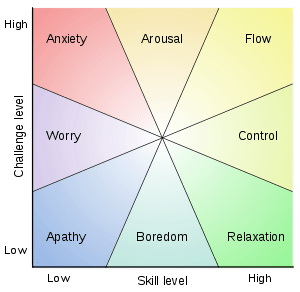
Let me tell you about two of my “flow” experiences before I begin to dissolve into senility. One of them was in the summer of 1968 while I was working in the architectural office of Fred Shellabarger, someone I claim as a mentor. Fred and Gladys had taken a cruise around the Mediterranean, with ports of call from Marseilles to Istanbul as I recall; we got postcards at the office. That summer I had become infatuated with the work of H. H. Richardson, especially his “Shingle Style” houses from the last years of his all-to-brief life—Richardson died in 1886 at the age of forty-eight. HHR may not have invented the Shingle Style but he certainly carried it to some of its greatest heights. Vincent Scully’s book on the subject can’t have entered my small library because it wasn’t published until 1974, so it might have been Jim Fitch’s book on American architecture that introduced me to it.
The library at OU was very good, exceptionally good for an undergraduate program. We had hard copy editions of many early periodicals, which enabled me to sit cross-legged in the stacks, block the aisles and wallow in dozens, if not hundreds, of examples. One night (while Fred and Gladys were still in Europe) I had a dream: I was living in a Shingle Style house and, like all dreams, I took for granted the family who shared the house and the rest of the dream with me. I woke early that morning—probably about six—with the image of that house so fresh that I threw on some clothes (pretty much the way I do even today, fashion plate that I am not) and ran to the office, strapped down a sheet of tracing paper and drew for the next hour or so, until others came in for the day’s work. But by that time, say ninety minutes tops, I had an eighth-scale ground floor plan and sixteenth-scale for the second. Oddly, the elevations of that house remained in my head until the Agincourt Project about six years ago, when I decided to complete the design and give it to one of the characters in the evolving story: James and Martha Tennant and their brood of four children, including young Anson, the would-be architect.
I still have that original drawing from 1968, as you can see.

Case study #2 happened some time in the mid-1980s, when Peter Ackroyd’s novel Hawksmoor was published. This was probably my first encounter with Ackroyd, the first of many happy reads, but this was special because its subject was an architect and one of my favorites at that: Nicholas Hawksmoor. The plot is devious, with alternate chapters set in the 18th century and the 20th. [Few authors write period dialogue as well as Ackroyd. Pick up one of his titles some time.] The 18th century character is Nicholas Dyer, an architect who resembles the actual Nicholas Hawksmoor in many ways. Dyer designs five London churches, each of which is the site of two ritual murders, one in the 18th century and another in the 20th. The 20th century crimes are investigated by Scotland Yard detective Nicholas Hawksmoor. Convoluted? That’s a large part of what grabbed my attention.
All of the actual London churches created by Hawksmoor are described in Ackroyd’s text but, here’s the catch, there is also an additional church not designed by Hawksmoor, or anyone else for that matter. Yet, Ackroyd’s description of it—leading us through the streets of post-fire London, block by block, turn by turn—is so vivid that I commandeered an unused desk in the Quonset [remember that treasure?], taped some tracing paper down and draughted the unkown Hawksmoor church in a couple of days. These antiques are also somewhere in my office, awaiting completion. Some day…and it had better be soon.
Keep an eye out here for the church of Little St Hugh.
It’s hard to design not on purpose.
Some designs are labored, like ten hours in the stirrups birthing a bowling ball.
As a man I’m happy to have been spared what the other, fairer sex endures to maintain the species. You’ve seen works of architecture that qualify: each aspect, every detail finessed, finagled, but more likely shoe-horned or bludgeoned into place. They reek of so much thoughtful purpose and purposeful thought that just looking at them induces migraine.
Try to imitate the work of another architect and you’ll see what I mean. Designing Agincourt’s public library in the style of Louis Sullivan may be the principal case in point. During these past seven years, I’ve learned a lot about Louie and at least as much about myself. I ain’t no Louie.
While that design continues to evolve—and it had better do it pretty quickly, because the model builders start next week—why not complicate matters by diving back into another old design: the original St Ahab’s church dedicated in September 1862, designed and at least partially built by its priest Francis Manning. I’ve written more than a few words about Fr Manning, to tell the story of those driven by faith in spite of significant obstacles in their path, but also to establish the point of view that drove the design of the church building in the first place. You can read about St Ahab/Christ-the-King in four sequential bogs entries written early in the story [just search for “Manning”] but here is perhaps the meat of Rev Manning’s vision:
No faith can be stronger than its foundation, and Rev Manning had laid it well. From a few fish and a ship’s mast she had built St Ahab’s, probably from her own design. She was, it turns out, from a coastal town on the Atlantic side of Ireland. So, if you visit the cemetery today and squint at the old church, there is something downright nautical about it, a misplaced vessel washed up on our shore and recycled like flotsam from the beach. It was apparently not in her nature or the nature of her people to waste time, resource or opportunity. She would be proud that we’ve carried on the tradition. Being green is hardly new.
Yesterday’s blog offered a set of parentheses for Saint Ahab’s: St Henry’s Ecumenical Chapel in Turku, Finland, by Sanaksenaho Architects, and a simple vernacular solution to the need for shelter at the shore, half of an upturned boat used as a shed, on the northeast coast of England near (if not actually on) Holy Island. Could I have chosen better inspiration? Our son Georg appended an image of St Benedict’s Chapel, a 1988 design by Peter Zumthor. I heartily approve of adding its character to the mix of factors that should push me toward a solution.

Here (and in the other two examples mentioned) is precisely what I mean about effortless design. Zumthor’s work is thoughtful to be sure, pensive without anguish; something done with the ease of breathing at rest. Douglas Adams had something to say about this very idea in The Hitchhiker’s Guide to the Galaxy, though I don’t have the quote at hand. It was something along the lines of “Oh, well, yes, then. It’s all right”.
You know what I mean.
“The most difficult task…”
“The most difficult task for a Communist historian is to predict the past.”
Years ago I ran across this quote somewhere on the web; I’ve not been able to find it since.
Agincourt works a lot like this: any building extant in the community today is likely to have at least one predecessor. Take Christ the King, for example. The 1950 building that serves the parish today replaced a red brick building of the 1890s. And that, in turn, had replaced the original church—St Ahab’s—built about 1860 but clearly outgrown by post-Civil War population increase.
The current building (designed by our friend Richard Kenyon channeling the Modernist vocabulary of mid-century architect Francis Barry Byrne) is successful on many levels—as an interpretation of Byrne’s actual work; as a piece of urban design; as narrative.
In the story of St Ahab/Christ-the-King, Father Farber had fallen from the roof of church #2 and damaged his optic nerve. But I have no idea what that building looked like. It was enough for me to know that the vestry roof was too steep for the aging but independent priest. It was an episode that helped establish his character.
Church #1—the original St Ahab—on the other hand was integral to the evolution of parish history; to the choice of the dedicatory saint himself. The parish’s founding priest, Rev Francis Manning, had also been a pivotal character whose calling was passionate and vision prophetic. How could I not like him? Especially when he turned out to be a she. The Vatican can’t be happy.
In my own peculiar way, the Communist historian’s task is mine: the present I’ve imagined is obligated to predict its past.
Saint Ahab’s
Reverend Manning had been born in Ireland, the oldest of several children. But the Potato Famine killed her parents and forced a migration to coal country in eastern Pennsylvania. What seemed important from her past was a high degree of remote-fishing-village independence transplanted ultimately to Iowa’s tall-grass prairie. Writing about it now—only now—can I see the prairie analogy to “seas of grass”.
I’ve tried a couple times to design the original St Ahab’s, but it defeats me. Clearly what I want is somewhere between these two images.

Tadao Ito (忠雄伊藤)
Among the most embarrassing episodes in American history—and they are manifold—is Executive Order #9066 signed by President Roosevelt on February 19, 1942. Though its effect on the American people wasn’t immediate, EO9066 paved the way for interment—open-ended imprisonment for the duration of the war—of Japanese Americans.
Recall that we were at war with Germany, Italy and Japan (and their allies), but Americans of German and Italian ancestry were not identified as a danger to the U.S. war effort. If EO9066 hadn’t singled out the Japanese, Milwaukee and large portions of New Jersey would have been emptied. Instead, it was Japanese homes and businesses that were confiscated; it was Japanese-Americans who were shipped to interment camps throughout the country—strategically away from areas sensitive to the war effort like manufacturing and munitions. Gordon Olschlager has already told this story through a design for the 1967 Fennimore County Courthouse.
In 2007 Gordon asked if Agincourt had a courthouse. I told him there had been an initial courthouse circa 1860s—framed in wood and probably late Greek Revival or Italianate in style. And that it had been replaced by a Richardsonian Romanesque design of 1888, a design that was indeed part of the 2007 exhibit. Then Gordon asked in there might have been another replacement, to which I replied: “Why don’t you decide when the ’88 courthouse is struck by lightening.” Two months later a crate arrived with the model of Gordon’s mid-century Modern conception: a spectacular design organized around the ruins of the previous building. A large element dramatically bridged the site and framed the vista between jail and the former courthouse. For those who haven’t seen it, we need to borrow Gordon’s model for the next exhibit.
I was an undergraduate at the University of Oklahoma from 1963 through 1968, so his design was eerily familiar. I may even have seen some of myself in it. But it was Gordon’s story that took my breath away. He had written the tale of a Japanese-American family in a Louisiana interment camp [I think it was Louisiana]: parents and two teenage children. The son died from incompetent medical treatment, but the daughter survived, attended architecture school [Tulane] and married a classmate from Iowa. Back in Des Moines, they entered a competition for the Fennimore courthouse. Many of Gordon’s Asian colleagues in Los Angeles gave authenticity to the story.
As we discuss the status and standing of hybrid Americans today—Hispanic Americans, Black Americans, gay and lesbian Americans, and others—I wonder if there were more to the story that Gordon had begun.
Tadao Ito
I also wonder if everyone thought interment was such a good idea.
I was born in 1945 but don’t recall much before about 1950. We were a working-class family nibbling at the edge of the Middle Class, and some of the language I heard in my youth wouldn’t pass the litmus test for “political correctness” today. But we change, don’t we; we grow.
My elementary and high school years are on my mind these days [50th high school reunion in two weeks!]. Argo-Summit and Bedford Park were populated with hybrid Americans; I could swear in ten languages by the age of ten, including Russian, Italian, Greek and Puerto Rican Spanish. Childhood had been picturesque. But Asians hadn’t been part of my experience. My loss. What I could imagine, however, was loyalty to the point of civil disobedience.
Enter Tadao Ito, a first-generation Japanese American marooned in Agincourt when the U.S. entered the war in December 1941. It may not be very architectural, but I can weave something from this simple idea.
Collateral Benefit
These days collateral has a nasty connotation: the leverage banks require for a loan or the death of non-combatants in an act of war. I’d like to think my Episcopal church project has had some positive collateral effect. Take the second group of biographies (mentioned in the previous entry Toward Product) as example.
“Bishops and Pawns” is a cluster of thirty or more short biographical sketches of clergy active in Dakota during the last territorial decade, 1879-1889. Bishops were rarely on the scene. Initially we were administered from Omaha by the elderly Bishop Robert Harper Clarkson, with responsibility for more than 225,000 square miles and no convenient way to reach its northwestern extremities than travel through the Twin Cities. I suppose Missouri River steamboats were an option. When the Missionary Diocese of North Dakota was finally established, Clarkson continued as bishop but was assisted by his brother in Christ, Henry Benjamin Whipple, Bishop of Minnesota, a good deal more conveniently situated. During those years, northern Dakota’s Episcopalians depended on the spiritual strength and physical stamina of yeoman priests—virtual circuit riders—like Rev B. F. Cooley who came to Fargo in the spring of 1881.

Cooley proves to have been a “type” among 19th century Episcopal clergy. A “High Churchman”—meaning he was drawn to Anglo-Catholic patterns of liturgy, music and design—he was born in Massachusetts at a time when his diocese was decidedly “Low” or Evangelical. His bishop Manton Eastburn was barely tolerant of such popish pageantry as elevating the host at communion and bowing during the liturgy of consecration. These actions got Cooley in trouble more than once. There were, have been and continue to be pockets of liturgical conservatism in the Episcopal denomination, so much so that a splinter denomination (the Anglican Church in North America) has formed from defecting parishes. Recently the entire Diocese of Quincy (Illinois) went its own way and sought refuge in the ACNA. In Cooley’s time such wholesale defection was unthinkable, so he migrated from parish to parish throughout New England, eventually seeking greater tolerance in dioceses like Newark and Chicago.
The frontier attracted High Churchmen like Cooley. It may be that their zeal needed the outlet afforded, even required, by frontier conditions, the paucity of resources, the virtual blank slate of a raw new community. So it made sense to have found him in Dakota as one of a string of priests at Fargo’s Christ Church (it would later be named Gethsemane). Cooley was here from 1881 into the fall of 1885, when he somehow ran afoul of the congregation and left town with the faint whiff of tar and feathers on the wind. The Fargo Argus is so circumspect about the reasons that we may never know. In a clerical career of nearly fifty years, however, Rev Benjamin Franklin Cooley served parishes in Massachusetts, Connecticut, New York, New Jersey, Maine, Dakota, Illinois and Wisconsin, returning ultimately to his hometown of Granville, Massachusetts where he died and was buried in 1913.
The priestly life had taken its toll on Rev Cooley. His marriage failed (they separated; clerical divorce being out of the question); he was driven from two parishes for unspecified reasons (Fargo and Eau Claire); he was hospitalized at least twice for fatigue. He and his wife Ellen Josephine (Hodges) Cooley had no children and he left no written legacy: letters, diaries, photographs, etc. But, oh my, he did leave churches in his wake!
At a dozen localities, he could legitimately claim to have organized a parish, raised funds, secured a lot and, at a time when the architectural profession was still forming, to have practically designed a half dozen churches independently or with benefit of architectural consultation. Cooley played a strong design role at both Lisbon and Casselton, as well as communities in Wisconsin and Massachusetts. And his hand can be detected elsewhere. So why not borrow him for a few months in Agincourt, Iowa?
To be more architecturally interesting, I had imagined the parish of St Joseph-the-Carpenter to have had an Anglo-Catholic orientation. And the time would ripe for Cooley’s presence: a few months after his departure from Fargo and before his appearance in Milwaukee. And those months would be more than enough to set the course of construction firmly on a path toward liturgical authenticity.

It’s comforting to think that the good father channelled a bit of himself through me in the design of St Joe’s.
Toward Product
I seem to be on a bender today about ecclesiastical architecture, especially the set of modest Episcopal churches built in Dakota Territory during the last decade before statehood. The process of researching this topic has consumed a lot of time since it began in the early 70s and it’s high time I did something about that. Promises have been made (to myself, to Dr Bob, among others), so it has become a matter of “Put up or shut down.”
A couple of entries back, I offered the word “prosopography” and suggested you might look it up. According to Wikipedia, prosopography
is an investigation of the common characteristics of a historical group, whose individual biographies may be largely untraceable, by means of a collective study of their lives, in multiple career-line analysis.
Without having heard the word, it seemed to me that the cluster of Dakota churches would be better understood through the lives of those who had both made and used them. Robert and Wynona Wilkins’s vantage was one-dimensional, dare I say myopic? Uncomfortably incorporating material culture into their denominational study [God Giveth the Increase], but with no explication of what those buildings more completely represented; indeed, with little awareness of how buildings actually happen. It may be that I have waited too long to make this point and offer another perspective on diocesan history, as well as in the field of architectural history itself.
Faith & Form: Victorian culture on the northern Great Plains
The working title of my manuscript may be too expansive. I am, after all, writing primarily about Episcopalians. But what you might be surprised to know is the disproportionate role that Yankee Episcopalians played, not only in the day to day life of northern Dakota, but in the very formation of the two states in 1889 from a territory that hindsight suggests ought to have been split by a north-south line, rather than an east-west one. The interests of Fargo, for example, have far more to do with those of Aberdeen than they do with the Black Hills or the Badlands. For those inclined toward “What if” history, try to imagine how an East Dakota and a West Dakota might have evolved economically, socially, politically.
If the historical event of statehood was a fulcrum, it was Episcopalians who tipped the balance.

The more material I gathered on these churches (in Fargo, Bismarck, Buffalo, Jamestown, Lisbon, Mayville, Pembina, Lakota and Devils Lake, and others outside the 1897-1889 time frame), the more logically it fell into categories of interest and agenda. The 150+ biographical squibs have settled into four sections (perhaps chapters) tentatively titled
- “The Landed Gentry”—a small but high profile presence here of Britons who had come from the landed gentry and even the nobility in the Old Country
- “Bishops and Pawns”—clergy in an hierarchical denominational structure, moving at times like chess pieces
- “Sticks and Stones”—architects and builders, carpenters, masons, etc., some of whom straddle those categories before the practice of architecture was regulated by the state
- “Butcher, Baker, Candlestick Maker”—the diverse laity in each community who served on vestries and building committees but who also had “day jobs” as newspaper editors, estate agents, bankers, lawyers, grocers, farmers, ranchers and, yes, politicians
The narrative that I intend to weave from these groups will, in my view, represent a fuller picture of life in Dakota during a few of its more strategic years.